Korea · 3,5 h · Fish · Side dish · For confident cooks
Chonggak Kimchi
In English: Ponytail Radish Kimchi
For 12 servings · US units
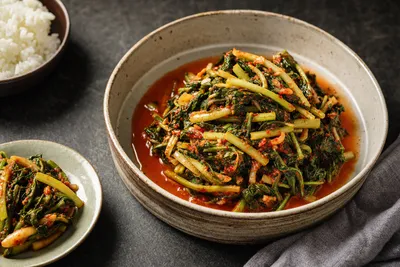
Young ponytail radishes with their greens, crisp and boldly spiced
Chonggak kimchi — known in English as "bachelor kimchi" — is made with young radishes, chonggak mu or altari mu in Korean, greens and all. The little radishes stay wonderfully crunchy while the paste of gochugaru, anchovy sauce and salted shrimp (saeujeot) rounds out over a few days. It's served cold as banchan, usually two or three pieces per person, and it keeps its flavor and snap for several weeks in the fridge.
Ingredients
- 3⅓ lbScrape the skin with a knife, do not peel; trim root tip, halve larger ones lengthwiseA small young radish, thumb to finger length, used together with its long leaves; the root is firm and crunchy, the greens pleasantly bitter.Substitute: There is no true substitute, because the shape, the firmness and the greens used alongside belong together. The closest option is a firm, slender daikon cut into thick batons or chunks, with radish or daikon greens added; the pieces soften faster during fermentation and the dish loses the whole roots with their leaf stems. Small red radishes alone are too small and too watery and soon go limp.Read more
- 3⅛ ozCoarse sea saltfor salting the radishes in layers
- 2⅛ ozstir into the cooled flour paste and let it swellKorean chili flakes made from sun-dried red chilies, ground coarse or fine. Bright red, fruity, mild to medium hot and slightly smoky.Substitute: The closest match is Aleppo pepper (pul biber) from a Turkish grocery, which is similarly fruity and mild but oilier, often salted and slightly tangier. In a pinch, mix sweet paprika with a little cayenne; this roughly matches colour and heat but not the fruitiness or texture. Ordinary crushed red pepper flakes are too hot to use in the usual quantities.Read more
- 2 tbspfor the paste; plain flour works as substituteFlour ground from glutinous rice, a particularly starchy rice variety; once cooked it turns chewy, elastic and sticky.Substitute: There is no good substitute. Ordinary rice flour or wheat flour will not bind into a chewy, elastic dough, and the result turns crumbly or short; tapioca starch adds some chewiness but is more glassy and tastes different.Read more
- 1 cupWaterfor the flour or rice paste
- 4 tbspfor the seasoning pasteA clear, amber seasoning sauce made from salted, fermented fish, in Korea usually anchovies; very salty and deeply savoury.Substitute: Thai or Vietnamese fish sauce can be used one for one; it tastes slightly different but works well. There is no true fish-free substitute: light soy sauce with a pinch of salt provides salt and some savouriness, but not the fermented fish note.Read more
- 2 tbspfinely chopped, for the seasoning pasteTiny shrimp packed in plenty of salt and fermented, a very salty, savoury paste with the small shrimp still whole.Substitute: Fish sauce is the usual stopgap, especially in kimchi and soups: it supplies salt and umami, but tastes of fish rather than shrimp and leaves no small pieces in the dish. As a dip for pork there is no workable substitute, because the flavour and bite of the whole shrimp are the point there.Read more
- 6 clovesGarlicminced or pureed
- 1 tbspGingergrated or finely minced
- 1 tbspSugarto round off and feed the fermentation
- 1 bunchSpring onioncut into roughly 5 cm pieces
- 1Onionfor the pureed seasoning base (optional)
- 1Applepureed along, for natural sweetness (optional)
- 6for a quick stock used in the paste; dried pollock works too (optional)Small whole anchovies, boiled and dried; salty and intensely briny, the base of many Korean stocks and crisp side dishes.Substitute: For stock, bonito flakes or Japanese dashi powder will do, though the result is smokier and more delicate, less robust; a splash of fish sauce in water is a stopgap that gives salt but little depth. For dishes in which the small anchovies are eaten whole there is no workable substitute, because the point is their bite and crunch; jarred anchovy fillets are too soft and too salty.Read more
Method
- Clean and trim the radishesWash the young radishes well, scraping the surface with the back of a knife rather than peeling them, trim off the root tip and carefully clean the dirt where the leaves meet the crown; pull off any yellowed or tough greens.
- Cut the larger radishesHalve or quarter the larger radishes lengthwise, leaving the greens attached at the crown so everything holds together.
- Salt the radishes and waitLayer the radishes with coarse sea salt, sprinkling as you go, and let them sit for 2 to 4 hours, turning them two or three times until they bend without snapping.
- Cook and cool the rice pasteWhisk the glutinous rice flour (or plain flour) into cold water until smooth, then bring it to a boil while stirring constantly until you have a creamy paste, and let it cool completely.
- Bloom the gochugaru in the pasteStir the gochugaru into the cooled paste and let it swell for 10 to 20 minutes, until the color turns deep and glossy.
- Finish the seasoning pasteMix in the anchovy sauce, finely chopped saeujeot, garlic, ginger, sugar and the green onions cut into roughly 5 cm pieces, then season with salt — raw, the paste should taste a touch saltier than you want the finished kimchi to be.
- Rinse and coat the radishesRinse the salted radishes gently two or three times in cold water and drain them well, then put on gloves and rub the seasoning paste over every surface, working it in between the leaf stems.
- Pack into the containerPack everything tightly into an airtight container, pressing down to push out air pockets, and don't fill the container all the way to the rim.
- Ferment, chill and serveLet the kimchi ferment at room temperature for 1 to 2 days, then move it to the fridge to mature; it's good to eat after a few days and hits its full flavor in about one to two weeks. Serve it cold as a side dish.
Tips and variations
If you like a smoother paste, blitz the onion, apple, garlic, ginger and saeujeot in a blender into a silky seasoning base instead of just mincing and stirring everything together. You can also make the flour paste with a quick stock of dried anchovies or dried pollock instead of plain water, and grated apple or a sweetener works just as well as the sugar. There's a faster route, too: 60 minutes of salting with a single turn is enough — and on the flip side, it's worth letting the radishes drain completely for 1 to 2 hours after rinsing. Cut larger radishes into bite-sized pieces after rinsing and leave the small ones whole; pressing a sheet of plastic wrap against the surface before sealing the container helps keep mold away. Serve cold as banchan, two to three pieces per person.
Allergens
Contains: Fish, Cereals containing gluten, Crustaceans
These notes follow from this recipe's ingredient list. Ready-made products and brands may contain further allergens — please check the packaging yourself.
Something not right?
This recipe was put together from independent sources and checked before publishing. Even so, a mistake can slip through — an amount that does not add up, a step that does not work as written. If you spot something, write to us: we will look into it and put it right.