Korea · 40 min · Fish · Soup · For beginners
Bugeoguk
In German: Suppe vom getrockneten Pollack · In English: Dried Pollock Soup
For 4 servings · US units
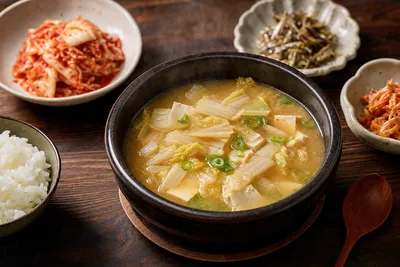
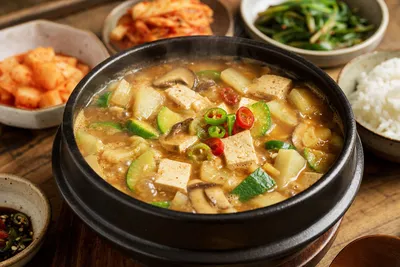
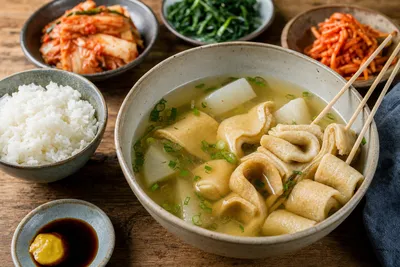
Korean dried pollock soup: milky-white broth with radish and egg
Bugeoguk is one of Korea's haejangguk, the soups you reach for the morning after — though it's just as good on an ordinary weekday. Dried pollock simmers with radish until the broth turns milky-white, clear and oddly refreshing all at once. Best of all, it comes together fast enough to pull off on a rushed morning.
Ingredients
- 1¾ ozshredded strips (hwangtae/bugeo), briefly soaked and torn into bite-size piecesAir-dried Alaska pollock, usually pulled into fibrous shreds, mildly savoury and barely fishy.Substitute: There is no truly equivalent substitute. Stockfish is related but must be soaked for days, is firmer and gives a less mellow broth; dried anchovies add savoury depth to a soup but taste much stronger and fishier and do not replace the fibrous texture.Read more
- 7 ozthinly sliced into flat pieces, sautéed with the fishKorean radish, shorter and stouter than Japanese daikon, with a greenish shoulder — firm, juicy, mildly peppery and slightly sweet.Substitute: Daikon or ordinary white radish work well; they are more watery and softer, cook faster and release more liquid in kimchi, so shorten cooking times and drain more thoroughly after salting.Read more
- 1 tbspfor sautéing; one source uses sesame oil insteadOil pressed from toasted perilla seeds, deep golden, nutty with a grassy, herbal undertone.Substitute: Toasted sesame oil is the obvious substitute and works in the same dishes, but it tastes rounder and sweeter, and the herbal, grassy note that defines perilla oil is lost entirely. There is no substitute that captures that note.Read more
- 6 cupsWaterinclude the pollock soaking water
- 2 clovesGarlicfinely minced
- 1Spring onioncut into lengths or diagonal slices, added at the end
- 1½ tbspfor seasoning; one source replaces it fully or partly with tuna fish sauceA pale, very salty Korean soy sauce made from fermented soybean blocks, used to season soups and vegetable side dishes.Substitute: The closest match is Japanese light soy sauce (usukuchi), which is also pale and salty but milder and lacks the earthy fermented note of the Korean sauce. Ordinary soy sauce is only a stopgap: it darkens broth and vegetables and tastes sweeter, so use less of it and make up the difference with a little salt.Read more
- 1Eggbeaten, drizzled over the boiling soup at the end
- Saltto taste
- Black pepperto taste
- 6 ozTofucut into bite-size slices (optional)
- 5¼ ozrinsed, cooked towards the end (optional)Caution: Soybean sprouts are not eaten raw but always cooked for a few minutes.Sprouted yellow soybeans with a large yellow bean head and a long, crisp stem, nuttier and sturdier than ordinary bean sprouts.Substitute: Mung bean sprouts will do at a pinch, but they are more delicate and watery and lack both the nutty flavour and the firm head; they need a much shorter cooking time.Read more
- 1cheongyang chili, sliced diagonally (optional)A fresh chili picked unripe, grassy and bright, ranging from mild to very hot depending on the variety.Substitute: For the mild variety, use long green peppers or mild green peppers such as Italian frying peppers; for the hot one, jalapeño or serrano. The fresh character stays the same, and you only need to adjust the amount for heat.Read more
- Chili powderonly for a spicier version (optional)
Method
- Soak the dried pollockRinse the dried pollock briefly, then soak it in warm water for up to 20 minutes. Squeeze it out gently, save the soaking water, and tear or cut the fish into bite-size pieces.
- Prep the vegetablesSlice the Korean radish into thin, flat pieces, cut the spring onion into lengths or diagonal slices, mince the garlic finely and, if using, slice the green cheongyang chili on the diagonal.
- Sauté radish and pollockHeat the perilla oil in a pot and sauté the radish and pollock together until the radish is half cooked through.
- Add the garlicAdd the minced garlic and stir-fry briefly, just until fragrant.
- Boil the broth milkyPour in the water along with the reserved soaking water, cover, bring to a boil and let it bubble away for about 8 minutes, until the broth turns milky-white.
- Add tofu and sproutsIf you like, add the tofu and soybean sprouts now and cook until tender.
- Season the soupSeason the soup with gukganjang, salt and black pepper.
- Finish with eggScatter in the spring onion and, if using, the chili, drizzle the beaten egg over the boiling soup and let it set without stirring. Then turn off the heat.
- Serve it hotServe hot, ideally in a tteukbaegi, the earthenware serving bowl, with a pinch of chili powder for extra heat if you want it.
Tips and variations
Instead of radish you can use a potato cut into half-moons and add tofu as well. Sesame oil works in place of perilla oil for the sauté, and if you're after more umami, season with tuna fish sauce instead of gukganjang, or half and half. One trick for a stronger, cloudier white broth: add the water in three batches rather than all at once. With soybean sprouts in the pot you can skip the egg altogether. Serve it hot in a tteukbaegi — straight from the stove to the table.
Allergens
Contains: Eggs, Fish, Cereals containing gluten, Soybeans
These notes follow from this recipe's ingredient list. Ready-made products and brands may contain further allergens — please check the packaging yourself.
Something not right?
This recipe was put together from independent sources and checked before publishing. Even so, a mistake can slip through — an amount that does not add up, a step that does not work as written. If you spot something, write to us: we will look into it and put it right.