Korea · 50 min · Fish · Soup · For beginners
Eomuk Guk
In German: Fischkuchensuppe · In English: Fish Cake Soup
For 2 servings · US units
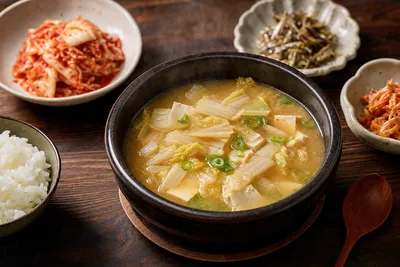
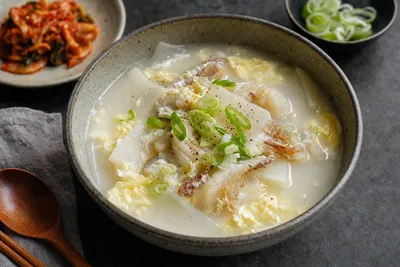
Korean fish cake soup in a clear anchovy broth with radish and skewers
Eomuk Guk is Korean weeknight cooking at its best: a clear anchovy and kelp broth with radish simmered until tender, and fish cakes — also called odeng — slipped in at the last minute. Folded onto wooden skewers they become odeng kkochi, and they come with the traditional dipping sauce of soy sauce with mustard or wasabi. Served hot with freshly cooked rice and a few side dishes, the bowl turns into a full meal.
Ingredients
- 7 ozsheets or sticks, usually frozen; rinse with hot water and cut into strips or skewerFried paste of white fish and a little starch, usually shaped into thin sheets; springy, mildly sweet and salty, and it soaks up broth.Substitute: The closest match is Japanese fried fish cake (satsuma-age) or fried fish balls from an Asian grocery, which are similar in flavour and texture but differ in shape. Steamed kamaboko is firmer and takes up less sauce. Western products such as fish fingers or surimi sticks are no real substitute, since they lack the springy texture and fall apart in broth.Read more
- 3½ ozpeeled, sliced or in large chunks; simmered in the brothKorean radish (mu), shorter and stouter than daikon, often pale green at the top, with firm, juicy, mildly sweet flesh.Substitute: Daikon or white radish works well, though it is more watery and less sweet, and turns softer when cooked. Some white radishes are also sharper, so taste before using.Read more
- 4¼ cupsWaterfor the broth
- ⅔ ozremove heads and black innards to avoid bitternessSmall whole anchovies, boiled and dried; salty and intensely briny, the base of many Korean stocks and crisp side dishes.Substitute: For stock, bonito flakes or Japanese dashi powder will do, though the result is smokier and more delicate, less robust; a splash of fish sauce in water is a stopgap that gives salt but little depth. For dishes in which the small anchovies are eaten whole there is no workable substitute, because the point is their bite and crunch; jarred anchovy fillets are too soft and too salty.Read more
- ⅓ ozdashima/kombu for the broth; remove before further simmeringCaution: Dried kelp is very high in iodine, so it should be used only in small amounts and not eaten in large quantities.Dried sheets of brown seaweed (Korean dashima, Japanese kombu), used above all to give broth a deep, savoury base.Substitute: There is no equivalent substitute; a pinch of glutamate seasoning or a little soy sauce adds savouriness but not the rounded, faintly oceanic taste, and the broth will be flatter.Read more
- 1 tbspSoy sauceto season the broth, partly light soup soy sauce
- 2 clovesGarlicfinely minced
- 1 ozspring onionssliced, added at the end
- 1 tbspmirin or cooking sake, tames the fishy noteA clear, mild wine made from fermented rice, used in Korean cooking mainly for marinades and to tame fishy smells.Substitute: Dry sherry or a dry white wine come closest, though they taste a little fruitier. If you use Japanese mirin the dish turns sweeter, so cut back slightly on the sugar in the recipe.Read more
- 1Onionquartered or roughly diced, for the broth (optional)
- 1 tspfor seasoning (optional)A clear, amber seasoning sauce made from salted, fermented fish, in Korea usually anchovies; very salty and deeply savoury.Substitute: Thai or Vietnamese fish sauce can be used one for one; it tastes slightly different but works well. There is no true fish-free substitute: light soy sauce with a pinch of salt provides salt and some savouriness, but not the fermented fish note.Read more
- Saltto taste
- Black pepperto taste, just before serving
- 1 tspfor a spicy broth or the dip (optional)Coarsely ground, sun-dried red chilies without seeds, bright red, fruity and only moderately hot.Substitute: There is no truly equivalent substitute. The closest are Turkish chili flakes (pul biber) from a Turkish grocery, somewhat hotter and saltier, or sweet paprika with a small pinch of cayenne, which matches the colour and heat but not the fruity, smoky depth. Ordinary chili flakes are far hotter and must not be used in the same quantity; for kimchi the real thing is worth seeking out.Read more
- 1 tspSugarrounds out the seasoning (optional)
- 3ssukgat, added at the very end (optional)The tender leaves and stems of the garland chrysanthemum, a leafy green with a strong herbal, slightly bitter aroma.Substitute: There is no real substitute, because the peculiar chrysanthemum aroma is not found elsewhere. The closest approach is watercress or rocket mixed with a little celery leaf, which hints at the bitterness and herbal note; young spinach matches only the texture and makes the dish noticeably milder.Read more
Method
- Start the brothClean the dried anchovies: pull off the heads and the black innards, otherwise the broth turns bitter. Put them in a pot with the dried kelp and the water.
- Cut the radish and onionPeel the Korean radish and cut it into slices or large chunks; quarter or roughly dice the onion.
- Simmer the vegetables gentlyAdd the radish and onion to the pot and let everything simmer gently for 15 to 30 minutes, until the radish is tender. Lift out the kelp early on so the broth stays clear and mild.
- Strain the brothFish out the anchovies and any remaining kelp and strain the broth. Either leave the radish in the soup or set it aside to plate separately later.
- Prepare the fish cakesThaw the fish cakes, pour hot water over them or blanch them briefly to wash off excess frying oil, then pat them dry. Cut them into bite-sized strips, or fold them onto wooden skewers.
- Season the brothSeason the broth with soy sauce, minced garlic, rice wine, salt and pepper; add fish sauce, a pinch of sugar or Korean chili flakes to taste.
- Steep the fish cakesSlide the fish cakes into the hot broth and let them steep for 3 to 10 minutes, spooning broth over the skewers as they sit. If you like, drop in chrysanthemum leaves right at the end.
- Garnish and serve hotScatter over the sliced green onion, grind fresh pepper on top and serve hot — with the dip, rice and side dishes.
Tips and variations
For a spicy version (maeun eomuk tang), season the broth with Korean chili flakes and gochujang instead of keeping it clear, or add Korean chili flakes to the anchovy broth while it simmers. In a hurry, skip the anchovies and build the broth from water, radish and kelp with hondashi, fish sauce and a pinch of MSG — ready-made or instant anchovy broth works just as well. If you have time, make the fish cakes yourself: purée lean white fish with rice wine, salt, egg, starch, ginger, onion and carrot, shape and deep-fry. To serve, put out a dip of soy sauce, garlic, green onion, sesame oil, sesame seeds, Korean chili flakes and sugar — or the classic soy sauce with yellow mustard or wasabi for dunking the skewers. The cooked radish is either eaten along with the soup or arranged as a side dish.
Allergens
Contains: Fish, Cereals containing gluten, Soybeans, Sulphur dioxide and sulphites
These notes follow from this recipe's ingredient list. Ready-made products and brands may contain further allergens — please check the packaging yourself.
Something not right?
This recipe was put together from independent sources and checked before publishing. Even so, a mistake can slip through — an amount that does not add up, a step that does not work as written. If you spot something, write to us: we will look into it and put it right.